News Story
Strain Sensors for Early Detection of Thermal Runaway in Cylindrical Lithium-Ion Batteries
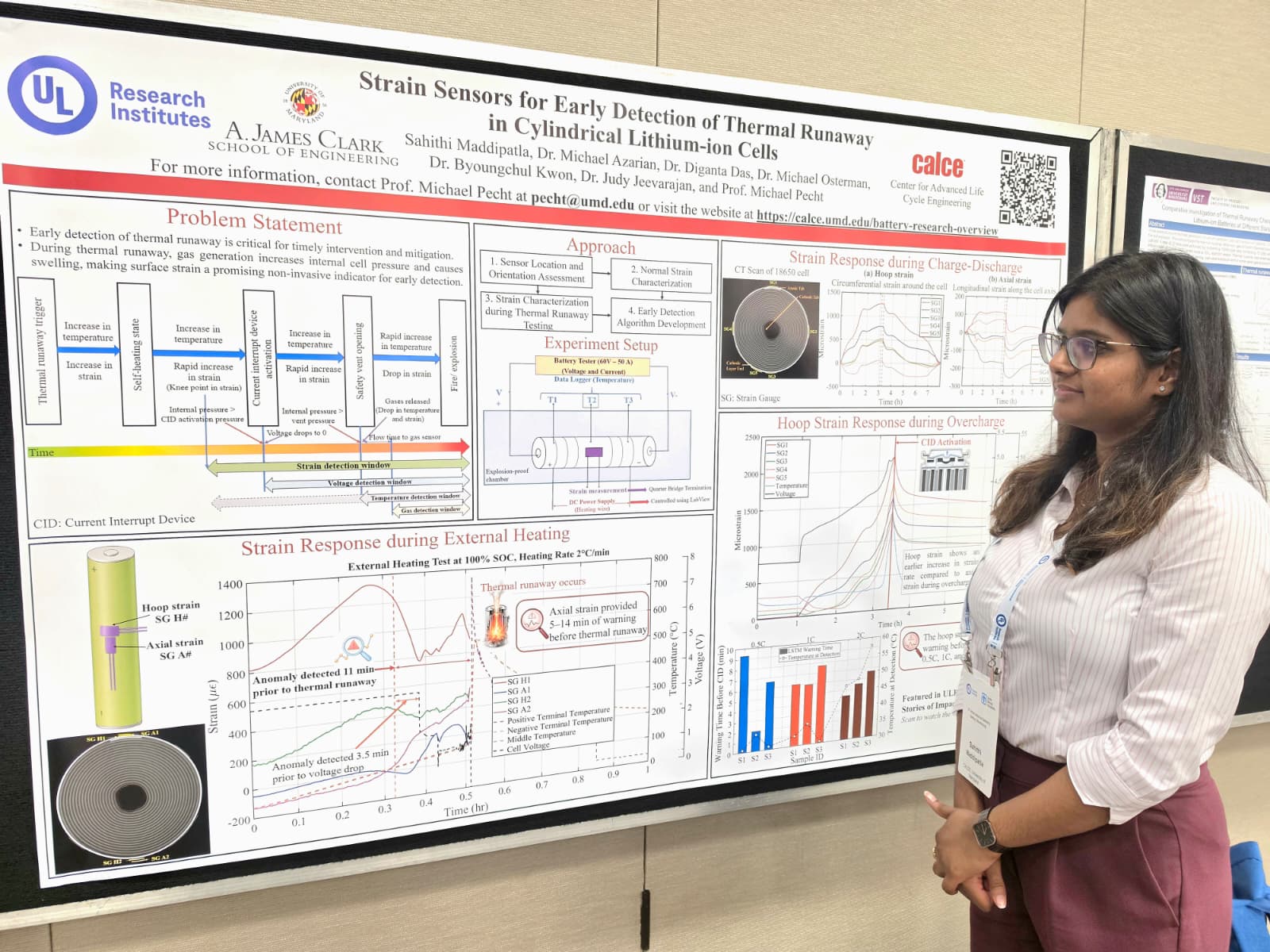
The 5th International Battery Safety Workshop (IBSW) was held August 30–September 1 in Houston, Texas, and was hosted by UL Research Institutes and Sandia National Laboratories. The workshop covered topics spanning the entire battery safety lifecycle, including materials and cell-level safety, cell-to-system design and integration, thermal runaway mechanisms, monitoring and early detection, data analytics and AI, thermal runaway mitigation, battery energy storage system (BESS) safety, and recycling safety. Sahithi Maddipatla, a doctoral candidate at CALCE, presented her work on the applicability and benefits of using strain sensors for the early detection and prevention of thermal runaway in lithium-ion batteries at the Workshop.
This research is featured in ULRI’s Stories of Impact - Watch the video
The work explores how mechanical changes in a battery’s casing can provide an early indication of gas generation and developing safety events. The poster presented the effect of strain-gauge location and orientation on strain measurements during charge–discharge cycling, overcharge, and external heating of cylindrical lithium-ion batteries. Changes in the strain response were then used to identify developing abnormal behavior prior to thermal runaway, demonstrating the potential of strain sensors as a simple, non-invasive approach for early battery safety monitoring.
One of the most valuable aspects of the workshop was seeing how battery safety is being addressed at different levels, from cell materials and failure mechanisms to system-level protection and field applications. The sessions on thermal runaway science, monitoring and early detection, and data analytics and AI were particularly relevant to my research. Presenting my work also provided an opportunity to receive feedback from researchers and industry experts and discuss how strain-based sensing could contribute to earlier detection of battery safety events. The workshop was also a great opportunity to learn about current challenges and emerging approaches in battery safety.
Related research papers can be found on CALCE’s battery publications page.
For information about CALCE’s broader work in battery safety research, contact Prof. Michael Pecht.
For additional information about this article and related work, contact Sahithi Maddipatla.
Published September 4, 2026
Recent Stories
Stories / Sep 23, 2026
Alchemity receives Breakthrough Energy Fellowship

Stories / Sep 15, 2026
Professor Lucy Qiu weighs in on statewide policy for data...

Stories / Sep 14, 2026
UMD Copper Ink Startup Receives Strategic Investment from E Ink

Stories / Sep 10, 2026
University of Maryland Researchers Develop Three Materials...

Stories / Sep 4, 2026
Strain Sensors for Early Detection of Thermal Runaway in...
Stories / Sep 1, 2026
CALCE Research Featured in Batteries Editor's Choice Articles

Stories / Aug 24, 2026
Two UMD engineering professors named to Technical.ly's 2026...

Stories / Aug 24, 2026
UMD Hosts Teachers for a Summer of Sustainable Cooling Research

Stories / Aug 19, 2026
UMD Develops ML Tool to Predict Uneven Airflow in AC Systems

Stories / Aug 12, 2026
Keeper of the Codes
