News Story
Two UMD engineering professors named to RealLIST Innovators 2026

Agonafer (left) and Wachsman (right)
Once a year, Technical.ly honors the “worker bees” who make the tech hive thrive.
The RealLIST Innovators spotlights Maryland inventors, scientists and engineers whose work is shaping the future of technology. Beyond their technical work, these leaders strengthen their communities by hosting meetups, launching podcasts and mentoring the next generation. This year, two of the fifteen selected are University of Maryland (UMD) engineering professors.
Dr. Eric Wachsman, Distinguished University Professor Materials Science and Engineering (MSE) and Director of the Maryland Energy Innovation Institute, is being recognized for establishing two energy companies, Ion Storage Systems (ION) and Alchemity, both of which contribute to a more sustainable energy future. ION’s solid-state battery technology delivers the safety, performance, and reliability that next-generation energy storage demands; while Alchemity is both transforming greenhouse gasses and wasted resources into valuable chemicals and fuels with a modular turn-key reactor system and developing next generation fuel cells.
Dr. Damena Agonafer, Associate Professor Mechanical Engineering (ME) and Clark Faculty Fellow, is turning his cooling research into a potential solution for more efficient computing. He has contributed to a more efficient way to cool computer chips using a tiny membrane to move heat away from the chip. The technology could tackle the growing challenge of keeping data centers cool — and the heat it captures could even be reused to warm buildings.
Currently, Wachsman and Agonafer are collaborating on a UMD Grand Challenges Impact Award looking at sustainable and ethical AI infrastructure. This initiative will integrate cross-disciplinary expertise to not only provide input to help guide the State of Maryland’s policy for AI and quantum data center deployment in the coming years, but to chart a national and global path toward sustainable and ethical AI infrastructure. The proposed innovations span several areas, guided by a high-level goal of how socio-technical energy systems respond when large-scale data center growth coincides with climate-driven grid disturbances. Using an interdisciplinary systems approach, this project integrates engineering analysis, economic modeling, GIS and machine learning, and policy design to assess how data center infrastructure growth affects grid reliability and environmental costs, community and household energy security, equitable cost-allocation mechanisms, and other areas. Moreover, the results will create a critically needed model for integrated Engineering, Economics, Policy and Business that can be applied to other states and regions across the U.S. and abroad.
“We are addressing this Grand Challenge on multiple fronts. ION’s batteries can enable greater use of solar and wind to power data centers and due to the higher efficiency of Alchemity’s fuel cells lower greenhouse gas emissions and cost when powered by natural gas or biogas.” said Wachsman.
Agonafer also noted, “Improving data center efficiency requires us to manage heat at its source. Our direct-to-chip two-phase cooling technology uses phase change to remove intense heat loads from high-power GPUs and CPUs while operating at higher inlet coolant temperatures. This can enable dry cooling, reduce dependence on chillers and water-intensive evaporative systems, and capture waste heat at temperatures that make recovery and reuse for building or district heating more practical.”
Published August 24, 2026
Related Stories
Stories / November 11, 2025
Clean Energy critical for quantum/AI

Stories / July 9, 2026
Alchemity Announces New Seed Financing

Stories / July 8, 2026
Solid Oxide Fuel Cell Breakthrough

Stories / June 26, 2026
Interdisciplinary team receives UMD Grand Challenges Impact...

Stories / June 25, 2026
MEII Director serves on Daily Record virtual panel discussion

Stories / June 8, 2026
Alchemity receives Build our Future Award from Governor Moore

Stories / May 13, 2026
2026 Invention of the Year: Engineering Projects Top List

Stories / November 14, 2025
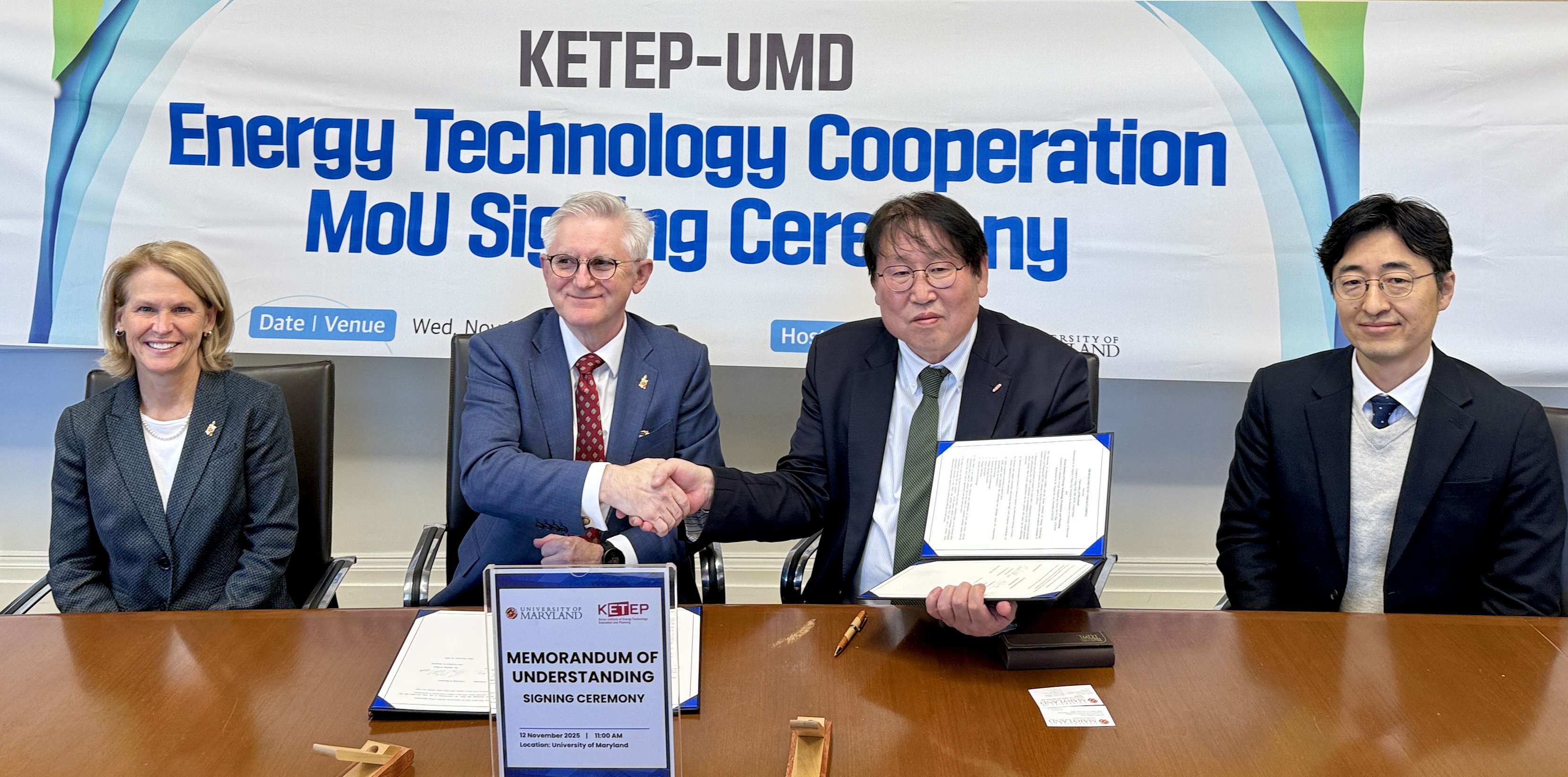
UMD - KETEP Research Collaboration Solidified
Stories / November 7, 2025
Wachsman named Materials Research Society Fellow

Stories / October 21, 2025
UMD Distinguished University Professor highlights US-France...